Material chapter 01 / Cement reduction
Reduce clinker without losing the brief
The first question is not how much cement can disappear. It is which binder can deliver the required performance with a better evidenced environmental balance.
Start with the clinker distinction
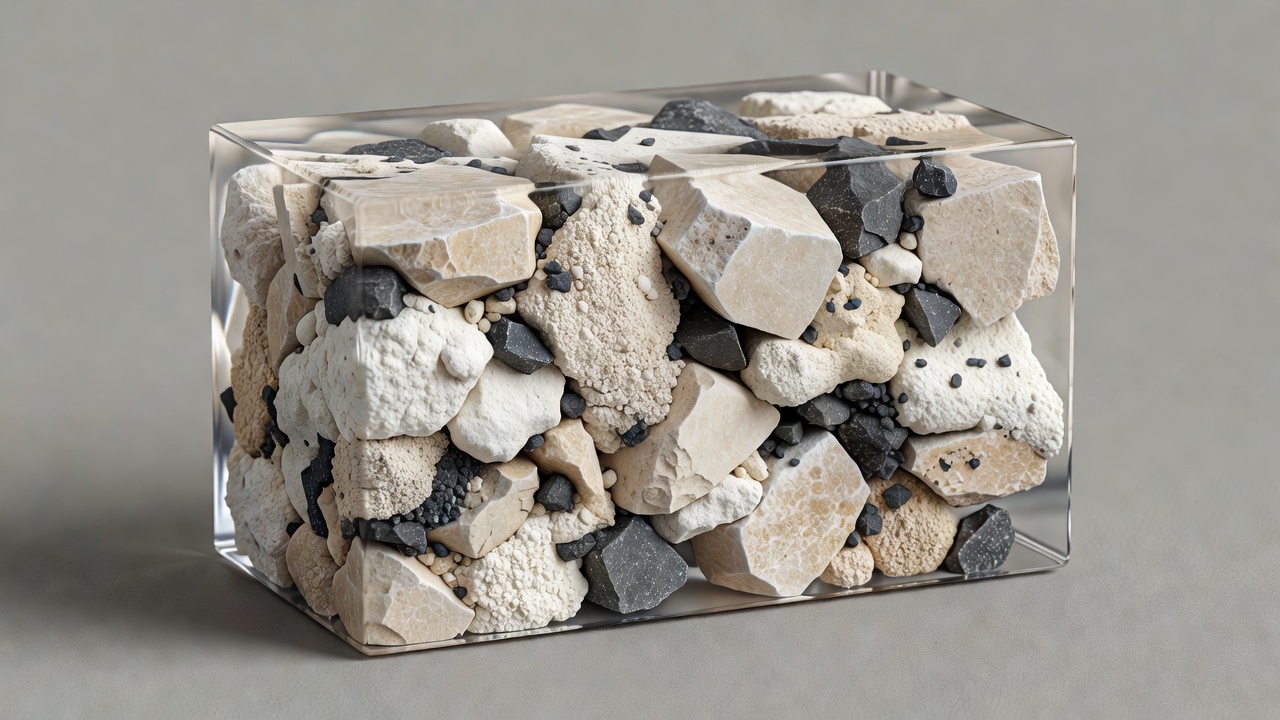
Cement and concrete are not interchangeable terms. Cement is a binder ingredient; concrete combines a binder system with water, aggregate and often admixtures. Portland clinker is made by heating mineral raw materials, with emissions arising from both fuel use and the chemical release of carbon dioxide from limestone. Reducing clinker content can therefore address an important part of concrete’s production-stage footprint. It does not remove the need to assess the complete mix.
A blended binder replaces or combines some clinker with other constituents. These may include ground granulated blast-furnace slag, suitable fly ash, limestone or calcined clay. Their roles differ. Some react with products of cement hydration; others contribute through hydraulic reaction, particle packing or interactions within the binder system. Calling all of them interchangeable “cement replacements” conceals differences that matter on site.
Match the constituent to the available supply
Slag and fly ash are linked to other industrial processes. Their availability, processing requirements and transport distances vary by region, and future supply cannot simply be assumed from historic use. A project should ask which material is being supplied, which quality controls apply and whether the proposed volume is realistically available throughout construction. An environmental comparison also needs to state how burdens from the originating process are allocated.
Calcined clay offers a different supply route. Suitable clay is thermally treated to develop reactivity, and some binder designs combine it with limestone. The LC3 research programme is a useful entry point into this chemistry, not a guarantee that any clay or any locally produced blend will perform identically. Mineralogy, calcination conditions, grinding and mix design influence the resulting material. Limestone content likewise needs to sit within a validated cement or concrete system, rather than being treated as an arbitrary dilution.
Clinker reduction is an intervention. Equivalent performance is the test.
Editorial synthesis; see the EN 206, BS 8500 and cement-standard entries in our evidence index.
Write the construction sequence into the brief
A binder that performs well at the specified assessment age may develop early strength differently from the reference mix. This can affect striking times, loading, finishing and cold-weather work. Curing is part of the material system: temperature, moisture retention and protection influence how the surface and bulk concrete develop. These effects should be discussed before a procurement decision locks the programme around an assumed familiar mix.
Do not turn those observations into a blanket judgement that blended cement is slow or unsuitable. Different combinations produce different responses, and admixtures or adjusted proportions can change behaviour. Ask the producer for relevant data, then use trial batches where the consequences justify them. Set acceptance criteria for the actual project, including any early-age requirements, rather than importing a single strength milestone without context.
Durability remains exposure-specific
Strength is only one part of suitability. A mix may face carbonation, chloride ingress, freeze–thaw action, chemical attack or other exposure conditions. Binder chemistry and curing can influence resistance to these mechanisms in different ways. A benefit against one mechanism does not demonstrate superiority against every other mechanism. Cover, crack control, workmanship and the intended service life remain part of the design.
Standards such as EN 206 and the UK’s BS 8500 provide a framework, but local adoption and permitted combinations must be checked. EN 197-1, EN 197-5, ASTM C595/C595M and ASTM C1157/C1157M address different cement frameworks and should not be treated as equivalent certificates. A supplier should identify the exact conformity basis and any additional evidence needed for the intended use.
Compare an actual mix, not a generic substitution
Request a product-specific EPD where available and examine the declared unit, production location, data period and lifecycle modules. Compare it with a technically suitable reference using compatible rules. Include changes in total binder content, aggregate, admixture dosage, transport and construction requirements where these affect the assessment. A lower clinker fraction does not guarantee a proportionate reduction in the concrete’s reported footprint.
Whole-life claims need a wider frame. Longer service life cannot simply be assumed, and a production saving should not be presented as a verified building-level reduction without checking the structure. Record both the environmental target and the evidence used to meet it. The strongest specification leaves room for a producer to optimise a compliant mix while keeping performance, carbon boundaries and acceptance procedures explicit.
Where to check the evidence
Begin with LC3 for limestone–calcined clay research, the Concrete Centre for UK specification guidance, and the BSI catalogue for applicable standards. Our evidence index distinguishes research, industry guidance and assessment rules.