Material chapter 04 / Aggregate reuse
Give existing mineral stock another role
Demolished concrete can become a useful feedstock. Whether it should become a particular aggregate depends on what is in it, how it is processed and where it will go next.
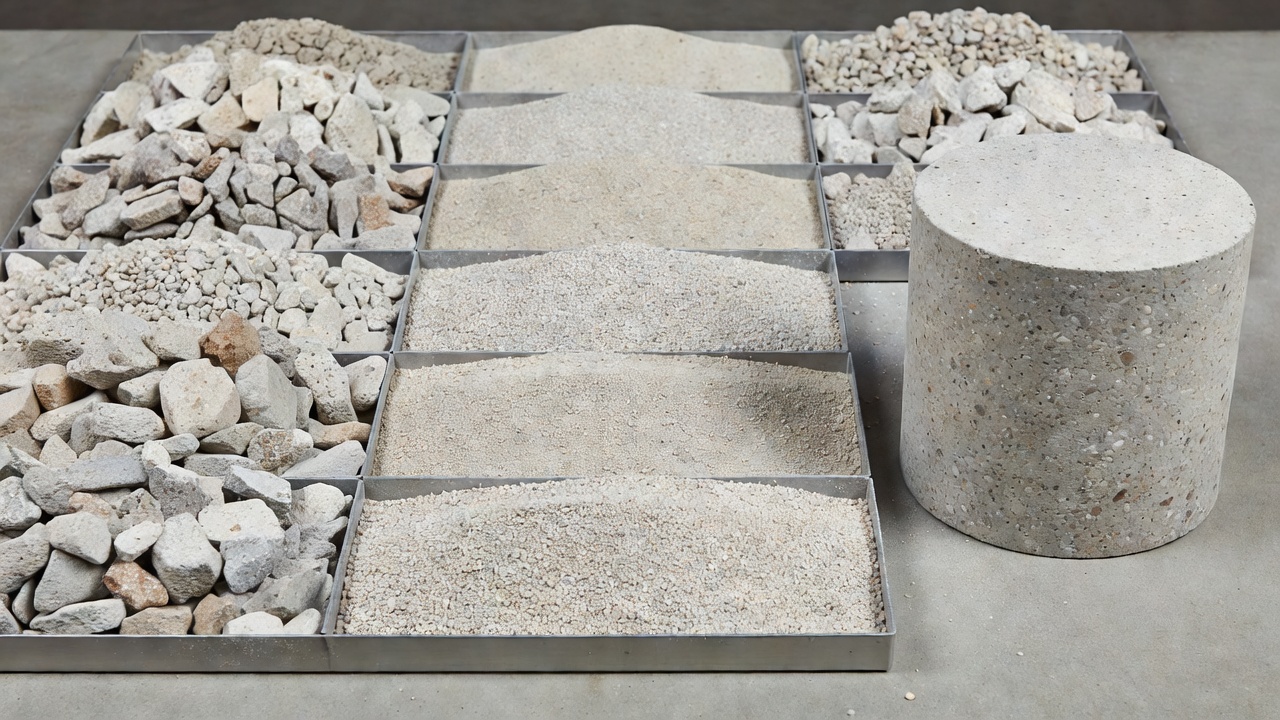
Begin before the crusher
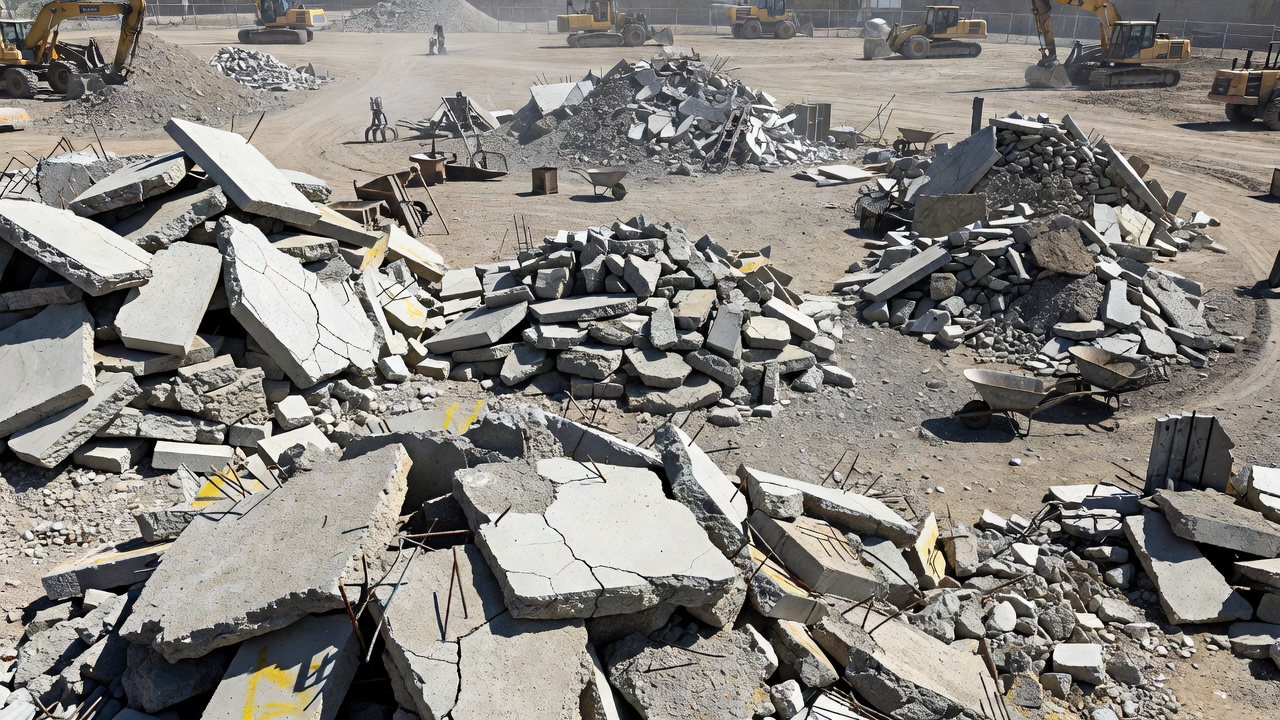
The quality of reclaimed aggregate starts with knowledge of the source. A selectively dismantled concrete structure can provide a more identifiable feedstock than mixed demolition waste. Records, pre-demolition surveys and segregation help establish what is being recovered. Concrete, masonry, gypsum, glass, timber and other materials do not become one predictable product simply because they pass through the same crusher.
Hazardous materials require appropriate assessment and management before processing. Past exposure can also matter: chlorides, sulfates or other contaminants may limit suitability. A specification should identify the permitted source types and require the tests relevant to the application. “Recycled” describes a history; it does not describe a complete aggregate quality class.
Understand the attached mortar
Recycled concrete aggregate often contains original aggregate with attached hardened mortar. That attached material can influence density, water absorption and variability compared with a natural aggregate source. Crushing and further processing affect particle shape, fines content and the amount of retained mortar. More intensive treatment may improve some properties while adding energy demand, cost and material losses.
Moisture control is particularly important. Aggregate absorption and initial moisture condition affect the water available in a fresh mix. Producers may need suitable conditioning, measurement and batching procedures to maintain workability and the intended effective water-to-binder relationship. Adding water informally on site is not a substitute for a controlled mix design and can undermine the performance the specification requires.
Specify the fraction and the destination
Coarse and fine reclaimed fractions can present different challenges and opportunities. Their permitted use depends on the applicable standards, quality and exposure conditions. A single project-wide recycled-content target can obscure these distinctions. State whether the target refers to aggregate mass, aggregate volume, a particular fraction or the complete concrete product. Otherwise, apparently comparable offers may be measuring different things.
Not every recovered mineral stream needs to return to structural concrete to be useful. Other applications may offer a sound technical and environmental destination. The right question is whether the proposed use retains useful value while displacing a credible alternative, without creating unnecessary processing or transport. A closed-loop story is attractive, but it still needs evidence about the actual next use.
Keep the resource story and the carbon story on separate lines until the evidence connects them.
Editorial principle informed by lifecycle assessment and aggregate specification frameworks.
Check the concrete, not only the aggregate
Aggregate conformity is necessary but does not establish the performance of every concrete mix containing it. Strength, stiffness, shrinkage, workability and durability can depend on the aggregate and the resulting proportions. Trial mixes and relevant production experience help determine suitable replacement levels. Structural design assumptions may need review where properties differ from those normally assumed for a familiar concrete.
EN 12620 and ASTM C33/C33M are important aggregate references in their respective contexts, while EN 206 and national provisions such as BS 8500 address concrete requirements. Their scopes and local applications need to be checked rather than blended into a generic global rule. A permitted percentage in one context should not be copied into another exposure class or jurisdiction without competent assessment.
Do not assume a carbon saving
Aggregate reuse can reduce demand for virgin mineral extraction and help manage construction waste. These benefits deserve attention even where the carbon effect is modest. But concrete’s binder can remain a major production emissions source, and changing aggregate does not directly remove that burden. If a revised mix uses more binder to maintain performance, that change belongs in the comparison.
Transport, crushing, washing, sorting and disposal of rejected material also matter. Compare realistic routes from the source to the processing plant and onward to the concrete producer or site. Avoid assuming that reclaimed material is local or that virgin material is distant. The avoided material and waste-management scenarios should be credible, and any allocation or end-of-life benefits should follow the chosen assessment rules.
Make traceability part of procurement
Ask the supplier to explain source control, sampling frequency, contaminant limits, grading, absorption and moisture management. Establish what happens when the demolition source changes. Stockpile segregation and delivery records can support traceability, but they need to connect to an actual quality system. For constrained supplies, plan an approved alternative rather than relying on an untested late substitution.
A well-written specification gives recovered stock a technically useful role without overstating what reuse achieves. It can set a resource objective and a carbon objective separately, then evaluate how the proposed mix addresses both. That approach leaves room for reclaimed aggregate to complement a lower-clinker binder or another intervention while requiring the combined product to earn its environmental claim.
Evidence and next steps
Consult the BSI catalogue and ASTM International for applicable aggregate and concrete standards. Use the Concrete Centre for UK guidance, and our evidence index for lifecycle assessment references.
Prepare an evidence enquiry